Designing with AI: building an augmented practice
When generative AI tools began to mature in 2022, I didn't wait for a brief. I started experimenting, first with Midjourney for image generation, then with large language models as they developed, asking myself the question: what can this technology actually do for design?
Not in theory. Not as a trend to reference in a pitch deck. In practice, on live projects, under real constraints.
The answer, it turned out, was substantial, but only through understanding of where AI adds genuine value, and where it doesn't. That distinction became the foundation of what I've built since.

Early Experimentation
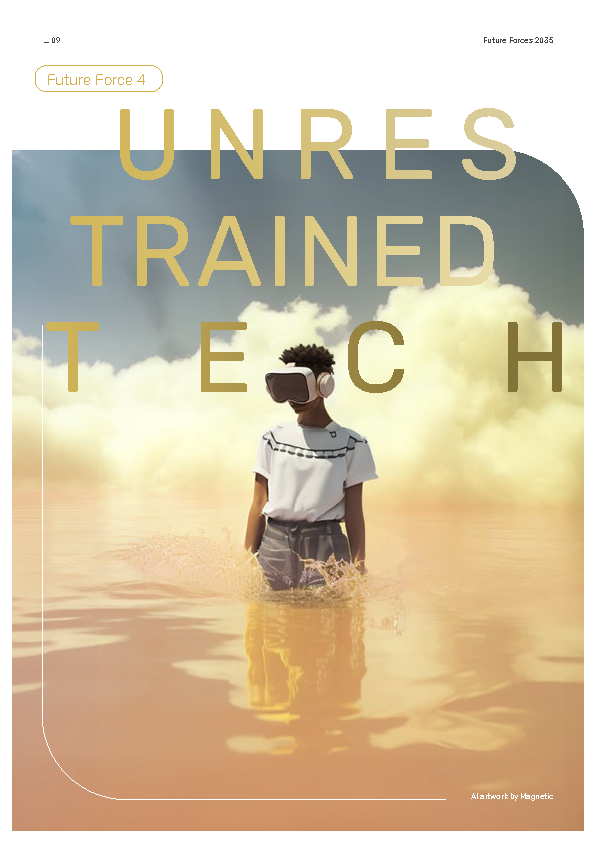
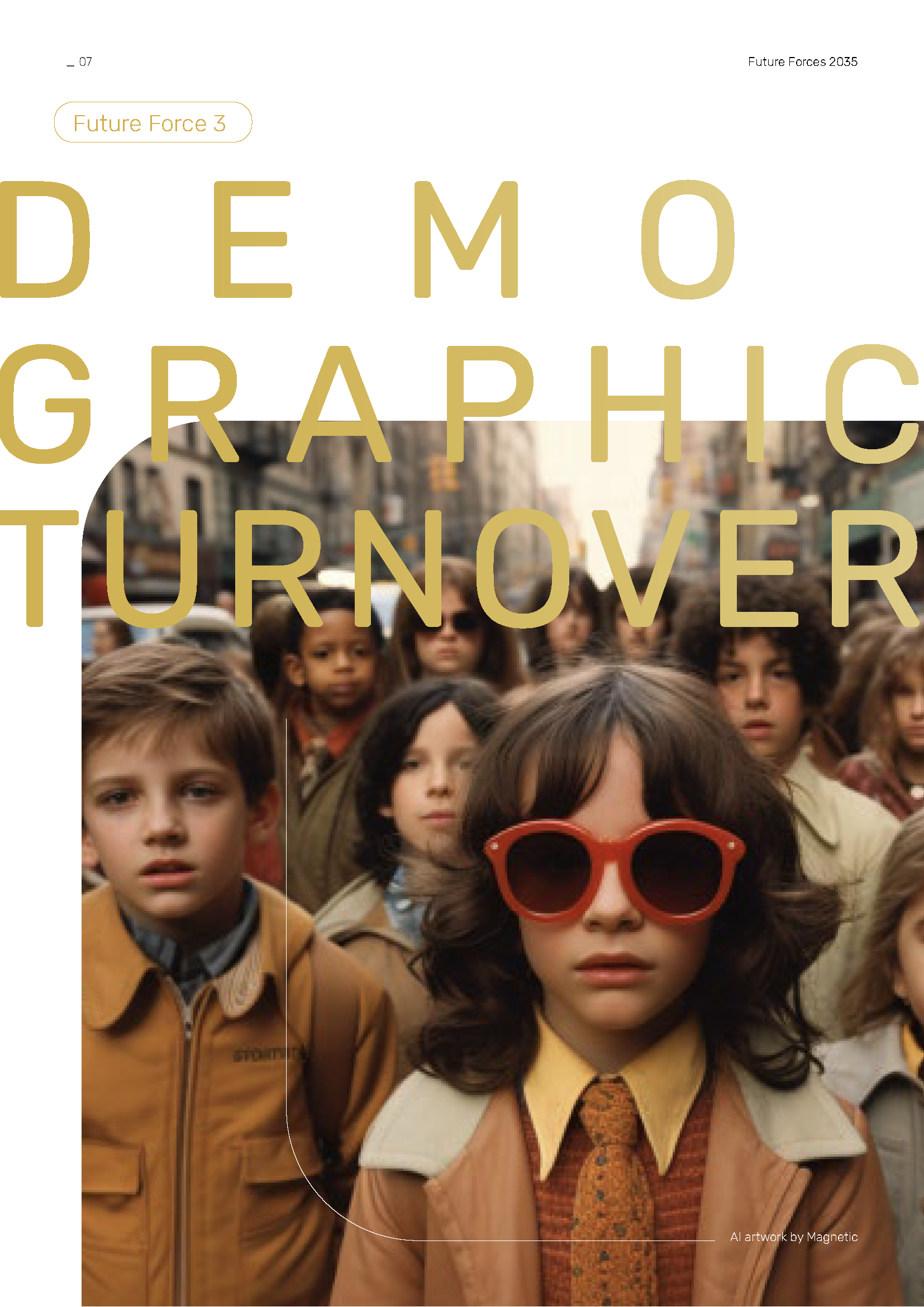
Future Forces was an foresight document I designed and edited looking at change drivers heading in to 2035. It combined my knowledge of graphic design and midjourney for image making


The Task Force
At Magnetic, I lead the AI task-force. Its remit is twofold: build internal capability so our designers work faster and sharper, and integrate AI into client-facing delivery so that the quality of what we produce visibly improves.
This isn't an innovation lab that produces thought-pieces. It's an operational initiative. The tools and methods we develop get used on real engagements, with real deadlines, for clients who care about outcomes.
The Tool Stack
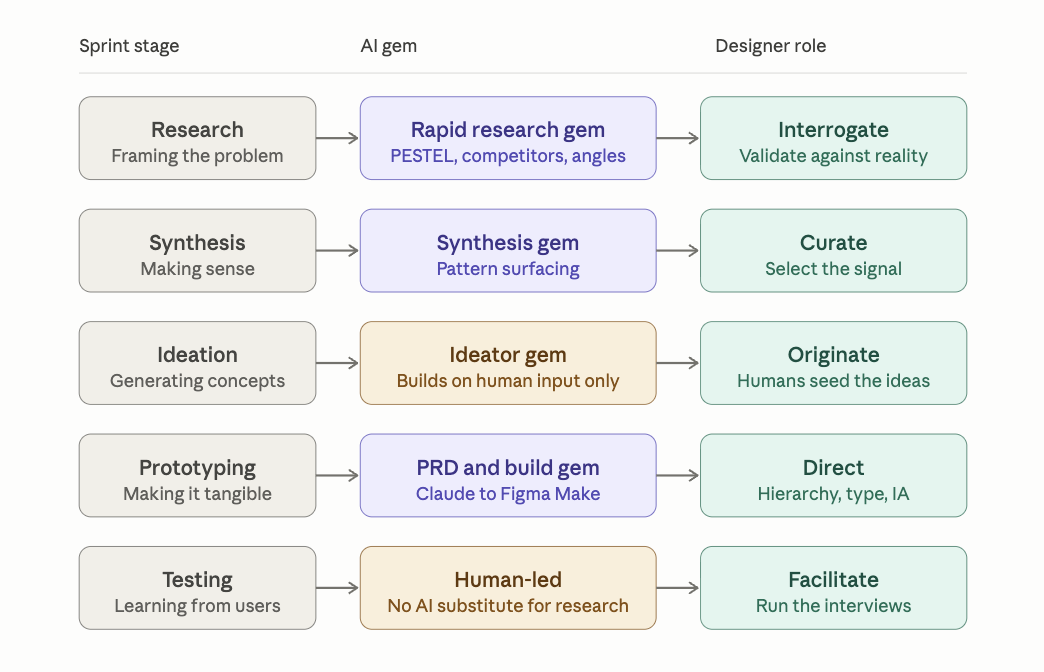
I've built a custom AI tool stack aligned to the design thinking process — a series of purpose-built tools, each designed for a specific stage of a design sprint.
One example: a rapid research tool that takes a loose problem statement and produces a PESTEL analysis, competitor landscape, and a set of promising problem areas to explore — work that would typically take a researcher several days, compressed into a structured starting point that a team can interrogate and build on within hours.
There are tools spanning the full arc of a sprint: research, synthesis, ideation, prototyping. But not every stage is AI-augmented, and that's deliberate. Ideation, for instance, has a too, but it's designed to build on ideas that humans generate first. People need ownership of their ideas for a sprint to work. If AI originates everything, you lose the commitment that makes co-creation valuable.
I'm currently developing this stack into an agentic system on Claude, a series of connected automations that can move through points of a design sprint as quickly as possible, without losing the quality that makes the output worth having.
In Practice:
The clearest demonstration of this approach came on a recent engagement, where we were tasked with improving product development governance a financial services companies’ pipeline.
I used AI to build a conceptual prototype, an application designed to give Product Managers an intuitive way to interact with products in their pipeline. The prototype linked real data via APIs and was structured around four use cases:
Build the Case — surfacing internal data around a specific product and using AI to help draft an investment case for a Stage Gate review.
Test the Idea — allowing PMs to pressure-test a product concept against existing Mastercard customer data to gauge potential traction.
Launch and Communicate — providing support for customer-facing communications around product enhancements.
Assess Momentum — giving a consolidated view of everything in the pipeline, tasks needing completion, and tracking status.
That last use case proved particularly resonant. During a group conversation, a senior EVP commented that she had no easy way to view everything in her pipeline. This feature, especially on mobile, offered exactly that: a quick, intuitive way to see how things are tracking without digging through multiple systems.
The prototype was built through a combination of AI-assisted development, working from a problem statement through to a product requirements document, and then refined in Figma. The speed was the point: we produced a functional, demonstrable concept fast enough that it became a conversation piece rather than a deliverable that arrived after the strategic decisions had already been made.
Where AI Stops and the Designer Starts
Working this way has sharpened my view on what design skill actually means now.
Technical and practical skills remain important, you still need to know how to structure information, run research, and build things. But taste has become more important than ever. When AI can produce plausible outputs at speed, the designer's role shifts toward curation: knowing what's good, what's nearly good, and what's confidently wrong.
On a recent prototype for the British Business Bank, the AI-generated output had a flat typographic hierarchy and an information architecture that didn't reflect how users would actually prioritise the content. I restructured the hierarchy myself and selected a more refined header typeface. The AI got the content right. The design judgment was mine.
This extends to research. AI can synthesise existing data, scan landscapes, and surface patterns. But there is no substitute for actual conversations with people. High-quality user research — interviews, observation, testing — remains the irreplaceable core of service design. AI makes the surrounding work faster. It doesn't replace the work that matters most.